
If you are importing goods into India- whether it’s raw material, machinery, or finished products one mistake in your import documentation can cost you thousands of dollars in customs delays, demurrage, penalties, or even seizure of goods. Yet, most businesses treat documentation as an afterthought until customs raises a query.
This guide breaks down everything you need to know about import documentation what it is, which documents are mandatory, common mistakes importers make, and how to keep your import process 100% compliant.
What is Import Documentation?
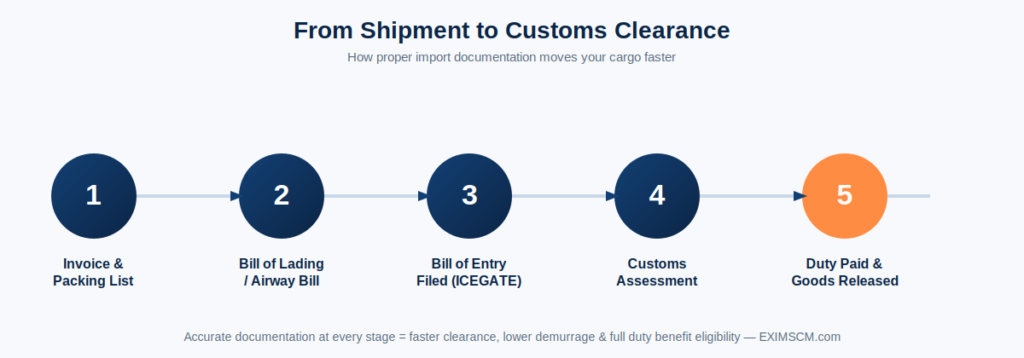
Import documentation refers to the set of legal, commercial, and regulatory documents required to bring goods into a country through customs. These documents establish the value, origin, classification, and legality of the shipment, and they are used by customs authorities, banks, and logistics partners to clear, verify, and process the shipment.
Proper import documentation is not just a formality, it directly affects:
- Speed of customs clearance
- Eligibility for duty benefits and exemptions
- Compliance with DGFT and RBI regulations
- Avoidance of penalties, detention, and demurrage charges
- Smooth closure of payment (EDPMS/IDPMS) with your bank
List of Essential Import Documents
Here are the core documents required for import documentation compliance:
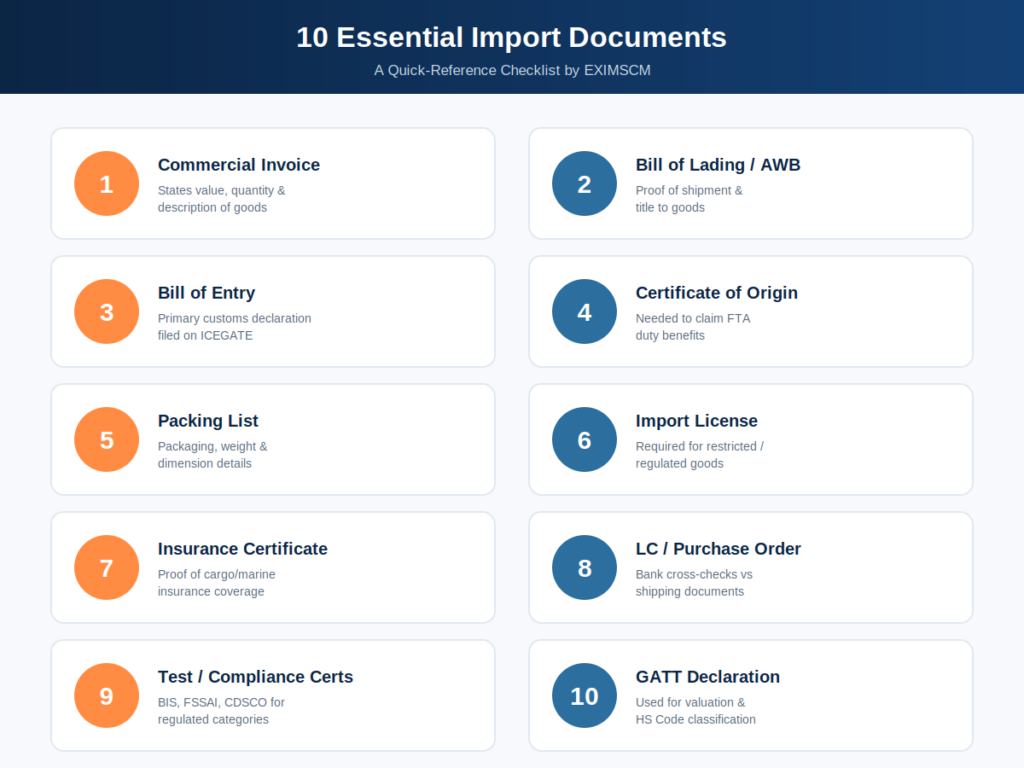
1. Commercial Invoice
Issued by the exporter/supplier, it states the value, quantity, and description of goods — the base document for customs valuation.
2. Bill of Lading (BL) / Airway Bill (AWB)
A transport document issued by the shipping line or airline confirming that goods have been shipped, and serving as proof of title.
3. Bill of Entry
Filed with Indian Customs (ICEGATE), this is the primary import declaration document required for clearance of goods and payment of applicable duties.
4. Certificate of Origin (COO)
Confirms the country where the goods were manufactured — critical for claiming duty benefits under Free Trade Agreements (FTAs).
5. Packing List
Details the packaging, weight, and dimensions of each package in the shipment, used by customs for physical verification.
6. Import License (if applicable)
Required for restricted or regulated goods as per the ITC (HS) classification and DGFT Foreign Trade Policy.
7. Insurance Certificate
Proof of marine/cargo insurance coverage for the shipment, often required for CIF-based imports.
8. Letter of Credit (LC) / Purchase Order
Required when payment is routed through LC — banks cross-check LC documentation against shipping documents before releasing payment.
9. Test Reports / Certificates of Compliance
For regulated categories (chemicals, electronics, food, pharma), additional certifications like BIS, FSSAI, or CDSCO approvals may be mandatory.
10. GATT Declaration & Technical Write-up
Used for accurate customs valuation and correct classification of goods under the HS Code system.
Common Mistakes in Import Documentation (and How to Avoid Them)
Mismatch between invoice value and declared value — leads to customs valuation disputes and penalties.
Incorrect HS Code classification — results in wrong duty calculation or denial of exemption benefits.
Missing or expired Certificate of Origin — importers lose FTA duty benefits they were otherwise eligible for.
Incomplete Bill of Entry filing — causes delays, demurrage, and detention charges at the port.
Non-closure of EDPMS/IDPMS — unresolved import remittance entries can attract RBI scrutiny and banking restrictions.
Ignoring DGFT license requirements — importing restricted items without a valid license can lead to seizure of goods.
Why Import Documentation Should Not Be Handled In-House Without Expertise
At EXIMSCM Global Business Consulting, we manage end-to-end import-export documentation and compliance for businesses across industries, including:
- Complete Bill of Entry & customs documentation support
- LC documentation and bank compliance
- EDPMS & IDPMS closure
- Classification of goods (HS Code advisory)
- Claiming eligible export/import duty benefits under FTAs
- DGFT & Customs query resolution
- Record management and audit-ready documentation systems
Our team combines deep regulatory knowledge with real-world customs experience to ensure your shipments move faster, your duty benefits are never missed, and your compliance record stays clean.
👉 Get a Free Consultation on your import documentation and compliance needs today.
Explore our full range of Export Import Compliance Services to see how we support businesses at every stage of global trade.