
Every business that imports, exports, or moves goods across borders operates under a web of laws — customs regulations, export control laws, sanctions, taxation rules, and country-specific trade agreements. Getting even one of these wrong isn’t just a paperwork problem — it can mean frozen shipments, blacklisting, heavy financial penalties, or loss of export privileges altogether.
This is exactly why international trade compliance has become a board-level priority for companies trading globally, not just a back-office function. In this guide, we break down what international trade compliance really means, why it matters more than ever in 2026, the biggest risk areas, and how businesses can build a compliance system that protects them instead of exposing them.
What is International Trade Compliance?
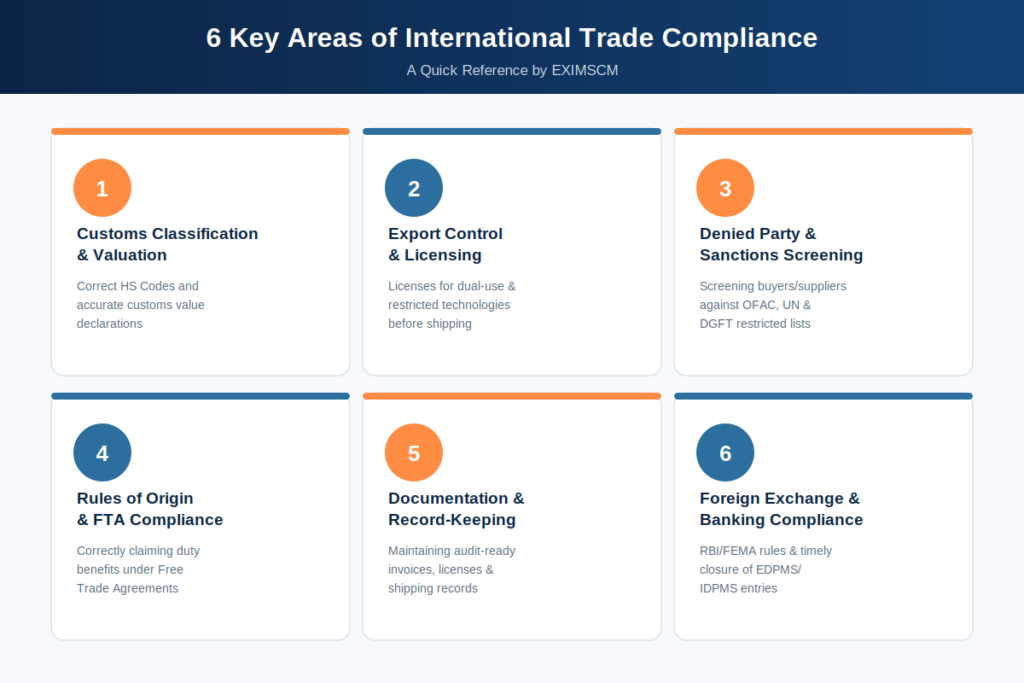
International trade compliance refers to the process of ensuring that all cross-border trade activities — imports, exports, shipping, invoicing, and payments — follow the laws and regulations of every country involved in the transaction. This includes compliance with:
- Customs laws and tariff classifications
- Export control regulations and licensing requirements
- Trade sanctions and denied party screening
- Foreign exchange regulations (RBI, FEMA in India)
- Free Trade Agreement (FTA) rules of origin
- Anti-dumping and countervailing duty regulations
- Documentation, labeling, and country-of-origin marking rules
In short, trade compliance ensures that a company’s global trade activity is legal, transparent, and audit-ready at every step — from the purchase order to the final customs clearance.
Why International Trade Compliance Matters More Than Ever
Global trade regulations have become significantly more complex in recent years due to:
- Rising geopolitical tensions — leading to frequent changes in sanctions lists and export control regulations.
- Stricter customs enforcement — governments increasingly use AI-based risk scoring to flag non-compliant shipments.
- Expanding FTA networks — more trade agreements mean more rules of origin to track and apply correctly.
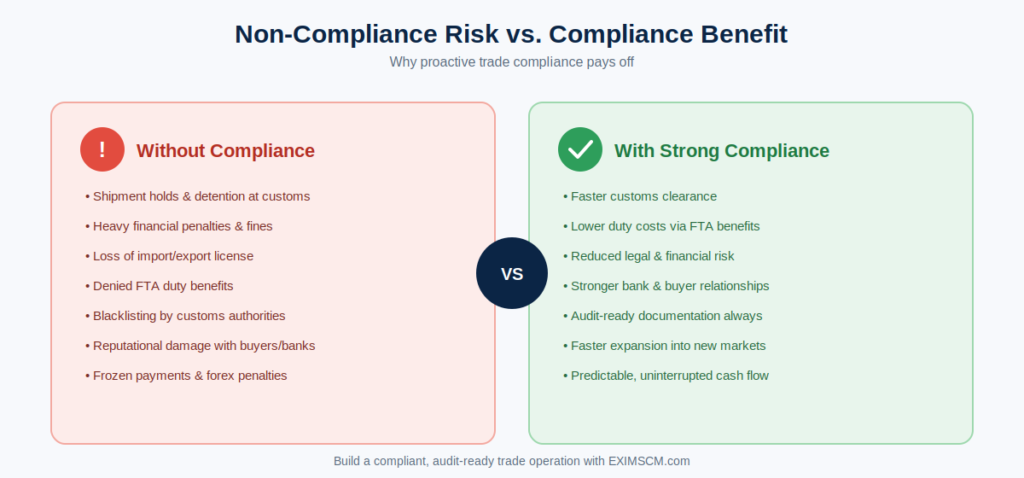
- Heavier penalties — non-compliance can now result in penalties running into crores, along with reputational damage.
- Supply chain scrutiny — buyers and banks increasingly demand proof of compliance before doing business.
A single non-compliant shipment can trigger audits across your entire trade history — making proactive compliance far cheaper than reactive damage control.
How EXIMSCM Helps Businesses Stay Trade-Compliant Globally
At EXIMSCM Global Business Consulting, we help importers and exporters build robust, audit-ready international trade compliance systems, including:
- End-to-end customs and documentation compliance
- HS Code classification and customs valuation advisory
- FTA rules of origin certification support
- Export licensing and regulatory approvals
- EDPMS/IDPMS closure and RBI/FEMA compliance
- Ongoing compliance audits and risk assessments
- Denied party screening process setup
Our team stays on top of constantly evolving global trade regulations so your business doesn’t have to — helping you trade with confidence, avoid penalties, and unlock every duty benefit you’re entitled to.
👉 Talk to Our Trade Compliance Experts for a free consultation on your business’s compliance needs.
Explore our complete range of Export Import Compliance Services to see how we support businesses across industries.